
Mudra (मुद्रा) is Sanskrit for "gesture": a gesture with a meaning, which is what a key binding is.
mudra is keybinding search for Vyom: one keyboard-driven panel that opens instantly, with live data, a preview and a key for everything. It runs on any compositor with the layer-shell protocol (sway, Hyprland, river, niri, Wayfire, labwc…). In Vayu, the desktop it was built for, it replaces keybind-search.py's wofi popup.
#Features
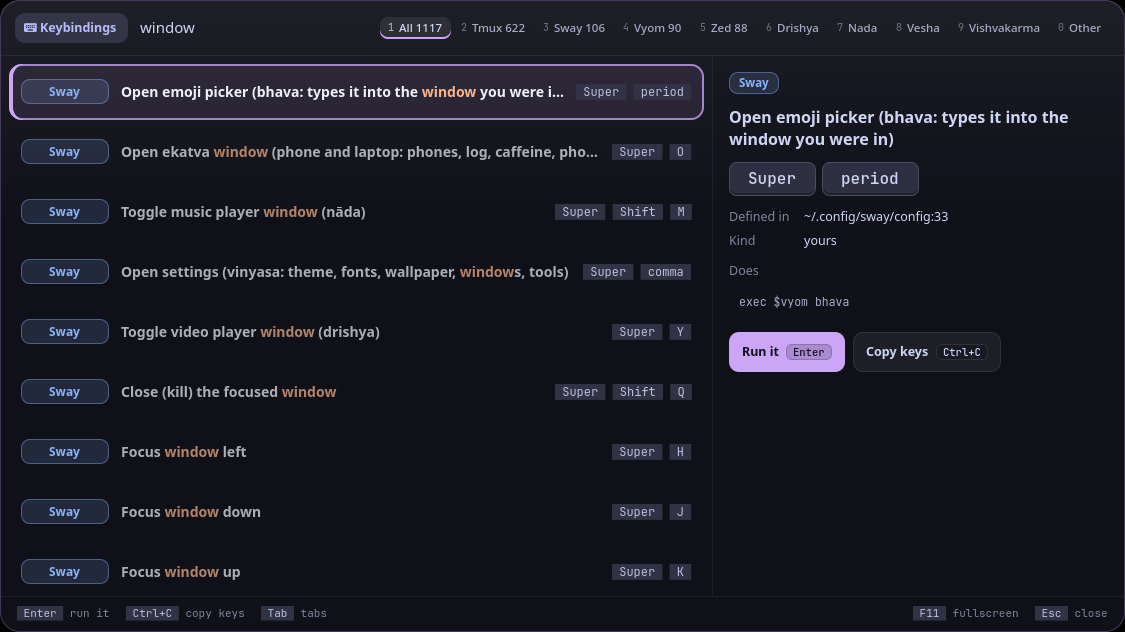
- Every keybinding by what it does ("kill window", "volume"), the words you typed in peach, with real key caps at the right and chords joined by a quiet "then" (
Ctrl A then &), in your theme's colours. - Each app is a coloured chip at the start of its rows (Sway, Tmux, Zed, Vyom…), always the same colour.
- Clashes stand out: a key bound twice in the same app and scope gets a red "Clash" chip, and the preview says what else it does.
- Or by its keys: type
ctrl+h,super q,alt 1,prefix sand you get what those keys do, exact matches first. - Vim and leader keys read as they're typed: a bare letter keeps its case (
g › gis notG), a Space-leader sequence is caps joined by a quiet › (Space › y › y) with the Space cap in your accent, and each row has a neutral mode chip (normal, insert) and a leader chip. - Which-key search:
space y(orspc y,<leader>y) lists everything underSpace y, in order, shortest first; the preview shows the path with the group names ("Space › y Copy › y the answer"). - A Leader tab: every tool's Space tree side by side. A key that uses a shared leader group for something else (Space m is mark in every tool, Space s sort…) gets a red Clash chip, as does a key bound twice in one mode or one that starts a longer one (
gbesideg g). - Every word counts, in any order: "tmux kill", "window kill", "wifi" (finds Wi-Fi).
- While you search, one list ranked by match; with an empty box, grouped by app with a count on each group.
- Vyom is one app with a section per tool (
Vyom · ganit,Vyom · tarang…), every panel's own keys first. A tool's name or title finds its keys: "ganit", "calculator", "tarang enter". - A tab per app, most bindings first (its count in the tooltip); the smallest apps share an "Other" tab.
Ctrl+2is the second,Tabthe next. - The preview shows the keys as big caps, where it's defined (
~/.config/sway/config:142for sway, kitty and zed; the file for a tool's own keys) and what it does, with Run it (Enter) and Copy keys (y y) buttons;oopens that file in $EDITOR at the line. Enterruns the binding: sway ones through swaymsg, tmux ones replayed into your most recent tmux client; anything else copies its keys.- Bindings come from a command printing JSON (Vayu's
keybind-search.py --json); without one it reads sway's own config. - Keyboard first: every action has a key, shown in the footer; the mouse works too.
- Never freezes the panel: slow commands run in the background.
#Install
#Requirements
- Vyom 0.6 or newer (Python 3.11+, PyGObject, GTK 4, gtk4-layer-shell, a Nerd Font)
- optional: swaymsg, tmux (running bindings)
#Install
git clone https://github.com/Theyashsawarkar/mudra ~/.local/share/vyom/plugins/mudra
vyom reload           # pick it up (or log out and in)
vyom mudra            # open it; run it again to close
Give it a key in your compositor, e.g. sway:
bindsym $mod+<key> exec vyom mudra#Update and uninstall
git -C ~/.local/share/vyom/plugins/mudra pull && vyom reload     # update
rm -rf ~/.local/share/vyom/plugins/mudra && vyom reload # uninstall#Usage
Open it with vyom mudra (or your key). It opens in insert mode: type to search. Esc goes to normal mode, where every key is a command and Space is the leader (a strip shows what comes next); i or / types again. The footer always shows the keys for what's selected.
Vyom's keys work too (every vim tool has them): ? and Space ? list every key, Space Space is the palette, j / k move, gg / G jump, / searches again, H / L switch tabs, q closes, Space u f is fullscreen, Esc steps back.
Insert mode (typing; mudra opens in it)
| Key | Action |
|---|---|
Enter | Run the selected keybinding (sway and tmux), else copy its keys |
Normal mode
| Key | Action |
|---|---|
Enter | Run the selected keybinding (sway and tmux), else copy its keys |
y y | Copy the selected keybinding's keys |
o | Open the file that defines it in $EDITOR (at its line when known) |
Leader (Space)
| Key | Action |
|---|---|
Space t a / Space t 1..9 | Switch to All / that app's tab |
Space f c | Show only clashes (or everything again) |
Space f m | Show only one mode's keys: normal, then insert, then every mode |
Space f d | Hide built-in keys (or show them again) |
Space f k | Search by keys only: dd, gg, x (or by words again) |
Space f l | Show every Space-leader key of every tool (the Leader tab) |
Space f f | Search again (clear the box and type) |
Space y y | Copy the selected keybinding's keys |
Space y d | Copy the selected keybinding's description |
Space y c | Copy the selected keybinding's command |
Space o e | Open the file that defines it in $EDITOR |
Space r | Read every keybinding again |
#Configuration
Everything is optional, in ~/.config/vyom/config.toml under [plugin.mudra]:
| Setting | Default | What it does |
|---|---|---|
source_command | keybind-search.py --json (if installed) | Command printing the bindings as JSON |
Run vyom reload after editing.
#Troubleshooting
- Nothing opens.
vyom listshows every installed tool, and why one is skipped (a missing requirement, or a Vyom that's too old). - It opened, then something failed. Look for a
Tracebackin the daemon's log,journalctl --user -u vyom -u vyom-daemon -b(without systemd:~/.local/state/vyom/daemon.log), and open an issue with it. - No blur or rounded corners. That's the compositor: on SwayFX, add
layer_effects "vyom" { blur enable; corner_radius 20; shadows enable }.
#The Vyom family
Each tool is its own repository, so you install only the ones you want:
| Tool | What it does | |
|---|---|---|
| dvara | द्वार, gateway | The app launcher |
| ganit | गणित, mathematics | The calculator and converter |
| smriti | स्मृति, memory | Clipboard history |
| bhava | भाव, feeling, emotion | The emoji picker |
| tarang | तरंग, wave | Wi‑Fi and the hotspot |
| setu | सेतु, bridge | Bluetooth |
| doot | दूत, messenger | Your phone, through KDE Connect |
| patra | पात्र, vessel | Docker containers |
| akashvani | आकाशवाणी, voice from the sky | Notifications |
| raga | राग, melody | YouTube music and video |
| mudra (this one) | मुद्रा, gesture | Keybinding search |
| urja | ऊर्जा, energy | The battery at a glance |
| vishram | विश्राम, rest | The power menu |
| kendra | केन्द्र, centre | Quick settings |
#Contributing
Bug reports, ideas and pull requests are welcome: see CONTRIBUTING.md for the development setup and the few rules every tool follows, and CHANGELOG.md for what changed in each release. Please report security issues privately (SECURITY.md).
#License
MIT.